Buy unterricht.eu ?
We are moving the project
unterricht.eu .
Are you interested in purchasing the domain
unterricht.eu ?
domain@kv-gmbh.de · 0541-91531010
Buy unterricht.eu ?
What is the actual difference between catalytic specificity and substrate specificity in enzymes?
Catalytic specificity refers to the ability of an enzyme to catalyze a specific chemical reaction, while substrate specificity refers to the ability of an enzyme to bind to a specific substrate. In other words, catalytic specificity is about the type of reaction that an enzyme can catalyze, while substrate specificity is about the specific molecule that an enzyme can bind to and act upon. Enzymes can have different levels of specificity for both their catalytic activity and their substrate binding, which allows them to carry out specific functions in the cell. **
What are substrate specificity and activity specificity using the example of restriction enzymes?
Substrate specificity refers to the ability of an enzyme to recognize and bind to a specific substrate molecule. In the case of restriction enzymes, they have substrate specificity for particular DNA sequences, known as recognition sites. For example, the restriction enzyme EcoRI recognizes and binds to the DNA sequence GAATTC. Activity specificity, on the other hand, refers to the specific chemical reaction that an enzyme catalyzes. In the case of restriction enzymes, their activity specificity is to cleave the DNA at specific recognition sites. For example, EcoRI cleaves the DNA at the GAATTC sequence. In summary, substrate specificity refers to the ability of an enzyme to recognize and bind to a specific substrate molecule, while activity specificity refers to the specific chemical reaction that the enzyme catalyzes. In the case of restriction enzymes, they have substrate specificity for specific DNA sequences and activity specificity to cleave the DNA at those sequences. **


Similar search terms for Specificity
Top-Angebote
Products related to Specificity:
-
Scholastic Teaching Resources Sight Word Readers Classroom Box SetJumpstart reading success with this irresistible collection of 125 little books that introduce and reinforce the first 50 must-know sight words! Each set includes a sturdy storage box stocked with 5 copies of 25 delightful tales—each presenting two...101,99 $*Shipping: 0,00 $Secure redirect to the provider
-
Perfect Picks Market Montessori Reusable Learning Cards Set For Kids Early Education Writing Practice Game Montessori Reusable Learning Cards Set For Kids Early Education Writing Practice GameTurn everyday learning into a fun, handson experience with these Montessori toys designed to spark curiosity and creativity. This engaging set of reusable cards helps young children build essential skills through play, making it perfect for early...39,97 $*Shipping: 0,00 $Secure redirect to the provider
-
Tiny Tots Teens Trends Drawer Game Early Education Montessori Wooden Pitch Ball Box Preschool Learning Training Toy Drawer Game Early Education Montessori Wooden Pitch Ball Box Preschool Learning Training ToyThis Montessori Wooden Pitch Ball Box Drawer Game is a thoughtfully designed earlyeducation toy that transforms playtime into purposeful learning. Crafted for toddlers and preschoolers, it offers a handson, engaging way to support key developmental...39,97 $*Shipping: 0,00 $Secure redirect to the provider
-
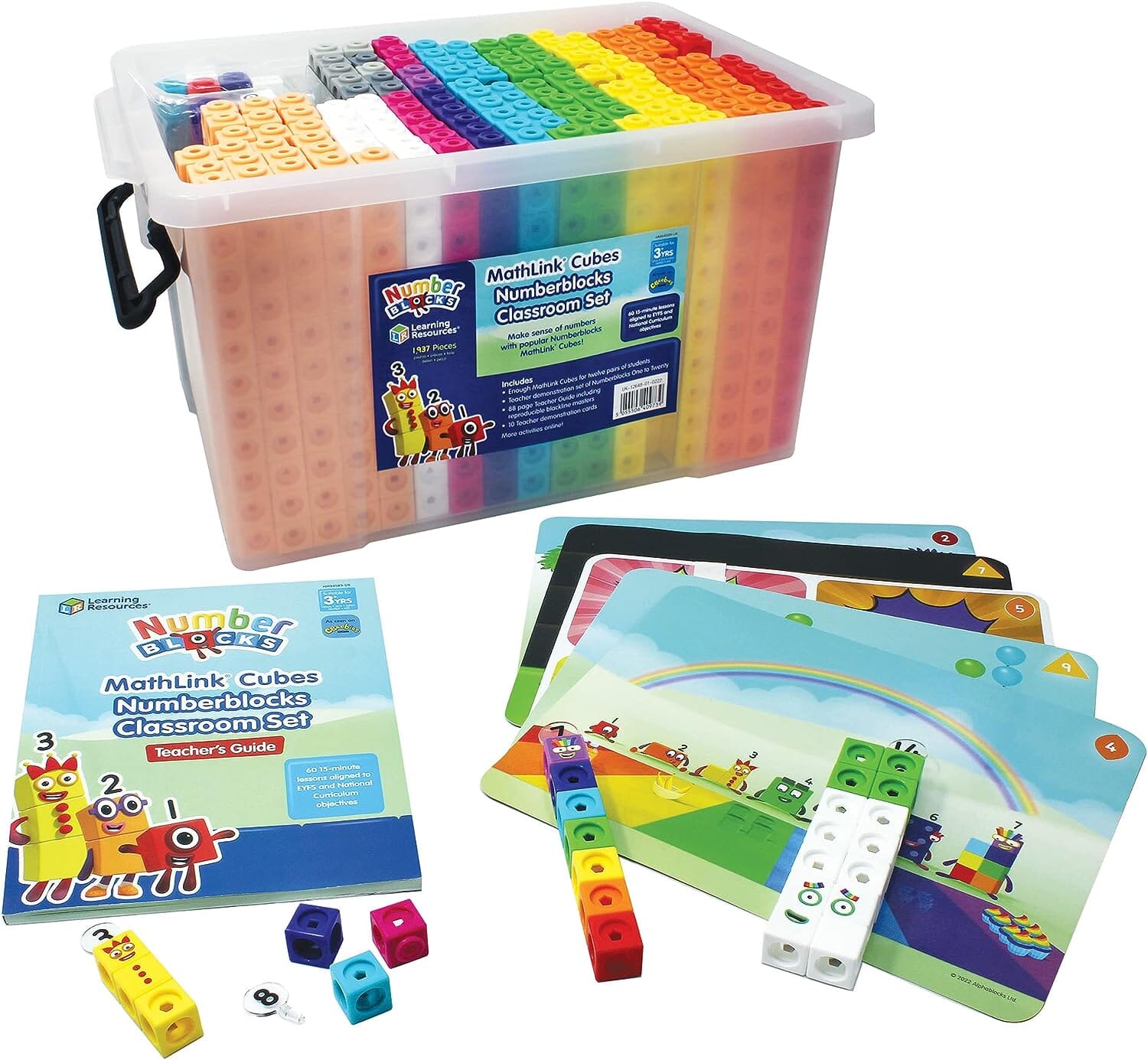
MathLink® Cubes Numberblocks Classroom Set - Ages 3+ - Educational Toy Learning ResourcesThis is the ultimate Numberblocks maths resources set developed to help teachers bring the maths concepts seen in the award-winning CBeebies TV series to life in the classroom. The set includes everything 12 pairs of pupils need to complete the 60 x 15-minute maths learning activities included in the comprehensive 88-page Teacher’s Guide. Activities align with the EYFS and National Curriculum objectives. The ultimate set for teachers to help children master maths by bringing the concepts shown in the award-winning TV series to life in the classroom. Developed to support maths learning in the classroom, this set uses the included comprehensive 88-page Teacher’s Guide to help children build essential early years maths skills including counting, place value, cardinality, subitising, composing and decomposing numbers, skip counting, addition, subtraction, and more for numbers 1-20. The quick and easy lessons incorporate group discussion and hands-on activities in 15 minutes. The Teacher’s Guide is split into three units. Unit one focuses on Numberblocks One to Five. Unit two focuses on Six to Ten, and unit three focuses on Eleven to Twenty. Lessons align with the EYFS and National Curriculum framework. The set has everything 12 pairs of pupils need to complete the activities featured in the Teacher’s Guide. Includes 1905 special edition Numberblocks MathLink Cubes, 20 Numberlings for One to Twenty, 5 double-sided demonstration cards, and the comprehensive Teacher’s Guide in a convenient storage tote.289,99 £*Shipping: 0,00 £Secure redirect to the provider



-
What is the substrate specificity of enzymes?
The substrate specificity of enzymes refers to the ability of an enzyme to recognize and bind to a specific substrate molecule. Enzymes are highly specific in their interactions with substrates, as they have active sites that are uniquely shaped to accommodate specific substrates. This specificity ensures that enzymes only catalyze specific reactions and do not interact with other molecules in the cell. Substrate specificity is crucial for the efficiency and regulation of biochemical reactions in living organisms. **
-
What is the biosubstrate specificity of bonds?
The biosubstrate specificity of bonds refers to the ability of enzymes to selectively bind to specific substrates and catalyze specific chemical reactions. Enzymes have specific active sites that are complementary to the shape and chemical properties of their substrates, allowing them to form temporary bonds and facilitate the conversion of substrates into products. This specificity is crucial for the regulation of biochemical pathways and the overall functioning of biological systems. It ensures that the right reactions occur at the right time and in the right place within the cell. **
-
What is the group specificity of enzymes?
Group specificity of enzymes refers to the ability of an enzyme to act on a specific functional group within a substrate molecule. This means that the enzyme can only catalyze a reaction involving a particular functional group, such as an alcohol or an amine. Enzymes with group specificity are highly selective and only interact with substrates that contain the specific functional group that they are designed to act upon. This specificity is important for the regulation and control of biochemical pathways in living organisms. **
-
What does the term cell type specificity mean?
Cell type specificity refers to the unique characteristics and functions of a particular type of cell within an organism. It means that certain cells are specialized to perform specific tasks or functions within the body, and they have distinct molecular and structural features that enable them to carry out these functions. This specificity allows for the coordination and regulation of various physiological processes within the organism, as different cell types can perform their specialized roles in a coordinated manner. Understanding cell type specificity is important for studying the development, function, and dysfunction of different tissues and organs in the body. **


What is the specificity of enzymes on substrates?
Enzymes are highly specific in their interactions with substrates, meaning that each enzyme typically catalyzes a specific chemical reaction with a specific substrate. This specificity is due to the unique three-dimensional shape of the enzyme's active site, which is complementary to the shape and chemical properties of its specific substrate. The enzyme-substrate interaction is often compared to a lock and key, where the enzyme (lock) can only bind to its specific substrate (key) due to their precise matching shapes and chemical properties. This specificity ensures that enzymes can efficiently catalyze specific reactions without interfering with other cellular processes. **
Could you please provide an urgent answer regarding specificity of effect?
Specificity of effect refers to the idea that a particular intervention or treatment has a targeted and precise impact on a specific outcome or condition, without affecting other unrelated factors. It is crucial to consider when evaluating the effectiveness of a treatment or intervention, as it helps determine whether the observed changes are directly linked to the intervention or if they could be influenced by other variables. Understanding the specificity of effect can help researchers and practitioners make informed decisions about the most appropriate course of action for addressing a particular issue. **
Top-Angebote
Products related to Specificity:
-
Perfect Picks Market Kids Learning Clock Silent Analog Teaching Wall Clock For Classroom & Bedroom Inch black 8 InchTransform learning into an exciting daily adventure with this Kids learning clock designed to help children master time with confidence. Featuring colorful numbers, clearly marked hands, and an easytoread analog display, it's perfect for young...54,97 $*Shipping: 0,00 $Secure redirect to the provider
-
JoyToys Montessori Wooden Learning Clock Time Teaching Puzzle For Kids Montessori Wooden Learning Clock Time Teaching Puzzle For KidsLearn through play with our wooden learning clock, designed to help children confidently understand time while developing essential early learning skills. This engaging Montessori clock combines handson puzzle play with interactive time practice,...29,97 $*Shipping: 0,00 $Secure redirect to the provider
-
Scholastic Teaching Resources Sight Word Readers Classroom Box SetJumpstart reading success with this irresistible collection of 125 little books that introduce and reinforce the first 50 must-know sight words! Each set includes a sturdy storage box stocked with 5 copies of 25 delightful tales—each presenting two...101,99 $*Shipping: 0,00 $Secure redirect to the provider
-
Perfect Picks Market Montessori Reusable Learning Cards Set For Kids Early Education Writing Practice Game Montessori Reusable Learning Cards Set For Kids Early Education Writing Practice GameTurn everyday learning into a fun, handson experience with these Montessori toys designed to spark curiosity and creativity. This engaging set of reusable cards helps young children build essential skills through play, making it perfect for early...39,97 $*Shipping: 0,00 $Secure redirect to the provider
-
What is the actual difference between catalytic specificity and substrate specificity in enzymes?
Catalytic specificity refers to the ability of an enzyme to catalyze a specific chemical reaction, while substrate specificity refers to the ability of an enzyme to bind to a specific substrate. In other words, catalytic specificity is about the type of reaction that an enzyme can catalyze, while substrate specificity is about the specific molecule that an enzyme can bind to and act upon. Enzymes can have different levels of specificity for both their catalytic activity and their substrate binding, which allows them to carry out specific functions in the cell. **
-
What are substrate specificity and activity specificity using the example of restriction enzymes?
Substrate specificity refers to the ability of an enzyme to recognize and bind to a specific substrate molecule. In the case of restriction enzymes, they have substrate specificity for particular DNA sequences, known as recognition sites. For example, the restriction enzyme EcoRI recognizes and binds to the DNA sequence GAATTC. Activity specificity, on the other hand, refers to the specific chemical reaction that an enzyme catalyzes. In the case of restriction enzymes, their activity specificity is to cleave the DNA at specific recognition sites. For example, EcoRI cleaves the DNA at the GAATTC sequence. In summary, substrate specificity refers to the ability of an enzyme to recognize and bind to a specific substrate molecule, while activity specificity refers to the specific chemical reaction that the enzyme catalyzes. In the case of restriction enzymes, they have substrate specificity for specific DNA sequences and activity specificity to cleave the DNA at those sequences. **
-
What is the substrate specificity of enzymes?
The substrate specificity of enzymes refers to the ability of an enzyme to recognize and bind to a specific substrate molecule. Enzymes are highly specific in their interactions with substrates, as they have active sites that are uniquely shaped to accommodate specific substrates. This specificity ensures that enzymes only catalyze specific reactions and do not interact with other molecules in the cell. Substrate specificity is crucial for the efficiency and regulation of biochemical reactions in living organisms. **
-
What is the biosubstrate specificity of bonds?
The biosubstrate specificity of bonds refers to the ability of enzymes to selectively bind to specific substrates and catalyze specific chemical reactions. Enzymes have specific active sites that are complementary to the shape and chemical properties of their substrates, allowing them to form temporary bonds and facilitate the conversion of substrates into products. This specificity is crucial for the regulation of biochemical pathways and the overall functioning of biological systems. It ensures that the right reactions occur at the right time and in the right place within the cell. **
Similar search terms for Specificity
-
Tiny Tots Teens Trends Drawer Game Early Education Montessori Wooden Pitch Ball Box Preschool Learning Training Toy Drawer Game Early Education Montessori Wooden Pitch Ball Box Preschool Learning Training ToyThis Montessori Wooden Pitch Ball Box Drawer Game is a thoughtfully designed earlyeducation toy that transforms playtime into purposeful learning. Crafted for toddlers and preschoolers, it offers a handson, engaging way to support key developmental...39,97 $*Shipping: 0,00 $Secure redirect to the provider
-
MathLink® Cubes Numberblocks Classroom Set - Ages 3+ - Educational Toy Learning ResourcesThis is the ultimate Numberblocks maths resources set developed to help teachers bring the maths concepts seen in the award-winning CBeebies TV series to life in the classroom. The set includes everything 12 pairs of pupils need to complete the 60 x 15-minute maths learning activities included in the comprehensive 88-page Teacher’s Guide. Activities align with the EYFS and National Curriculum objectives. The ultimate set for teachers to help children master maths by bringing the concepts shown in the award-winning TV series to life in the classroom. Developed to support maths learning in the classroom, this set uses the included comprehensive 88-page Teacher’s Guide to help children build essential early years maths skills including counting, place value, cardinality, subitising, composing and decomposing numbers, skip counting, addition, subtraction, and more for numbers 1-20. The quick and easy lessons incorporate group discussion and hands-on activities in 15 minutes. The Teacher’s Guide is split into three units. Unit one focuses on Numberblocks One to Five. Unit two focuses on Six to Ten, and unit three focuses on Eleven to Twenty. Lessons align with the EYFS and National Curriculum framework. The set has everything 12 pairs of pupils need to complete the activities featured in the Teacher’s Guide. Includes 1905 special edition Numberblocks MathLink Cubes, 20 Numberlings for One to Twenty, 5 double-sided demonstration cards, and the comprehensive Teacher’s Guide in a convenient storage tote.289,99 £*Shipping: 0,00 £Secure redirect to the provider
-
Perfect Picks Market Kids Emotional Expression Mirror Early Education & Emotional Learning Toy For Toddlers blueNurture your childs emotional intelligence with the Kids Emotional Expression Mirrora fun, interactive learning tool designed to help toddlers understand and manage their feelings. This innovative toy features six emotional expression cards and a...49,97 $*Shipping: 0,00 $Secure redirect to the provider
-
Perfect Picks Market Kids Learning Clock Silent Analog Teaching Wall Clock For Classroom & Bedroom Inch white 8 InchTransform learning into an exciting daily adventure with this Kids learning clock designed to help children master time with confidence. Featuring colorful numbers, clearly marked hands, and an easytoread analog display, it's perfect for young...54,97 $*Shipping: 0,00 $Secure redirect to the provider
-
What is the group specificity of enzymes?
Group specificity of enzymes refers to the ability of an enzyme to act on a specific functional group within a substrate molecule. This means that the enzyme can only catalyze a reaction involving a particular functional group, such as an alcohol or an amine. Enzymes with group specificity are highly selective and only interact with substrates that contain the specific functional group that they are designed to act upon. This specificity is important for the regulation and control of biochemical pathways in living organisms. **
-
What does the term cell type specificity mean?
Cell type specificity refers to the unique characteristics and functions of a particular type of cell within an organism. It means that certain cells are specialized to perform specific tasks or functions within the body, and they have distinct molecular and structural features that enable them to carry out these functions. This specificity allows for the coordination and regulation of various physiological processes within the organism, as different cell types can perform their specialized roles in a coordinated manner. Understanding cell type specificity is important for studying the development, function, and dysfunction of different tissues and organs in the body. **
-
What is the specificity of enzymes on substrates?
Enzymes are highly specific in their interactions with substrates, meaning that each enzyme typically catalyzes a specific chemical reaction with a specific substrate. This specificity is due to the unique three-dimensional shape of the enzyme's active site, which is complementary to the shape and chemical properties of its specific substrate. The enzyme-substrate interaction is often compared to a lock and key, where the enzyme (lock) can only bind to its specific substrate (key) due to their precise matching shapes and chemical properties. This specificity ensures that enzymes can efficiently catalyze specific reactions without interfering with other cellular processes. **
-
Could you please provide an urgent answer regarding specificity of effect?
Specificity of effect refers to the idea that a particular intervention or treatment has a targeted and precise impact on a specific outcome or condition, without affecting other unrelated factors. It is crucial to consider when evaluating the effectiveness of a treatment or intervention, as it helps determine whether the observed changes are directly linked to the intervention or if they could be influenced by other variables. Understanding the specificity of effect can help researchers and practitioners make informed decisions about the most appropriate course of action for addressing a particular issue. **
* All prices are inclusive of VAT and, if applicable, plus shipping costs. The offer information is based on the details provided by the respective shop and is updated through automated processes. Real-time updates do not occur, so deviations can occur in individual cases. ** Note: Parts of this content were created by AI.